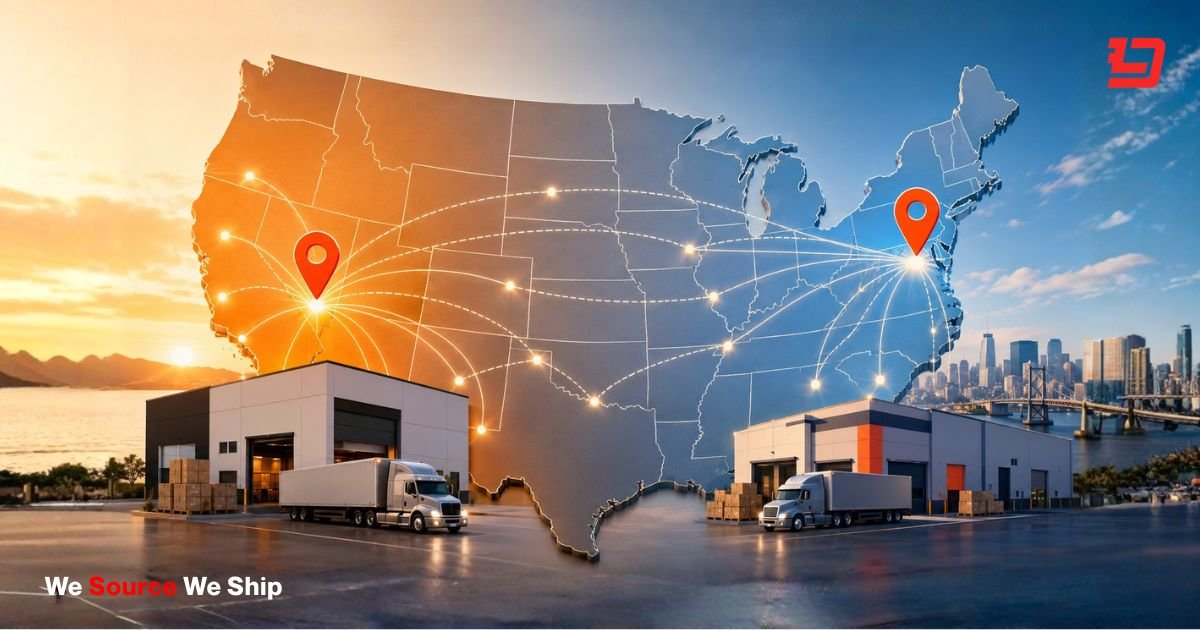
Choosing between an East Coast and West Coast warehouse should come down to where your customers are, where your inventory enters the U.S., and how much you spend moving orders across shipping zones. A West Coast warehouse often makes sense for brands importing from Asia or serving western customers, while an East Coast warehouse can improve access to major eastern markets. For nationwide ecommerce fulfillment, using both coasts may be the more practical option.
East Coast vs. West Coast Warehousing at a Glance
There is no universally better warehouse location. The right choice depends on your supply chain.
| Factor | East Coast Warehouse | West Coast Warehouse |
|---|---|---|
| Best customer concentration | Northeast and parts of the eastern U.S. | California, Southwest, Pacific Northwest |
| Common inbound advantage | Imports routed through East Coast ports; products originating from Europe may have a more direct route | Imports from China and other Asian manufacturing hubs |
| Nationwide parcel delivery | Longer distance to western customers | Longer distance to eastern customers |
| Suitable for | Brands concentrated in eastern markets | Brands concentrated in western markets or sourcing heavily from Asia |
| Bi-coastal role | Supports eastern order volume | Supports western order volume |
For parcel shipping, distance matters because carrier zones and transit times vary by origin and destination. That means warehouse placement can directly affect both shipping speed and parcel costs.
When Does a West Coast Warehouse Make More Sense?
A West Coast warehouse is often the stronger starting point when your products enter the U.S. from Asia and a significant share of your customers are in western states.
1. You Source or Manufacture in Asia
For businesses manufacturing products in China, Vietnam, or other Asian markets, the West Coast provides a geographically direct entry point into the U.S.
West Coast distribution can shorten the movement of imported products into inventory and reduce inbound transportation requirements, particularly for goods entering through Pacific gateways.
This can be particularly relevant to established ecommerce brands that source in China. However, inbound freight should not be considered in isolation. Saving time on the ocean leg may not compensate for repeatedly shipping parcels across the country if most customers are in the Northeast.
2. Your Customers Are Concentrated in the West
If a large share of orders comes from California, Nevada, Arizona, Utah, Washington, or nearby markets, locating inventory in the West reduces the distance products travel after checkout.
That can make ground shipping more practical and reduce reliance on faster, more expensive services for western customers.
3. You Want to Coordinate Asian Imports With Western Fulfillment
For brands that manufacture in China and maintain meaningful western U.S. demand, a West Coast 3PL can create a relatively straightforward flow:
Factory → Pacific import route → West Coast fulfillment center → customer
This can reduce unnecessary inland movement before orders are fulfilled.
When Is an East Coast Warehouse the Better Choice?
An East Coast warehouse is often preferable when a large proportion of your customers are concentrated in eastern markets or when your inbound logistics already favor East Coast gateways.
1. Your Customer Base Is Heavily Eastern
The eastern U.S. includes major ecommerce markets around New York, New Jersey, Pennsylvania, Boston, and Washington, D.C. A warehouse positioned closer to these customers can reduce parcel travel distance.
The same principle applies in reverse: relying only on a West Coast facility can leave eastern orders traveling through more distant shipping zones.
For a brand with the majority of sales east of the Mississippi, placing inventory close to those orders can matter more than choosing the warehouse closest to its import port.
2. Your Products Enter Through Eastern Ports
Not every Asian import must enter through California, and brands sourcing from Europe may find East Coast routes particularly relevant. Port strategy has also become more diversified as shippers use New York/New Jersey, Savannah, Virginia, Charleston, and other gateways alongside West Coast ports.
The important calculation is total landed logistics cost, not ocean freight alone. Compare:
- International freight
- Port and drayage costs
- Inland transportation to the warehouse
- Storage and handling
- Parcel shipping to customers
A slightly more expensive inbound route can sometimes make sense if it substantially reduces outbound fulfillment distance.
Why Customer Geography Should Drive Your 3PL Fulfillment Strategy
Order history is one of the most useful tools for deciding where inventory should sit.
Export six to twelve months of orders and group them by ZIP code or state. Then ask:
- What percentage of orders ship to the East, West, South, and Midwest?
- What are your current average parcel zones?
- Where are your highest-volume customers?
- How much are you spending on expedited shipping?
- Which products sell fastest in each region?
Do not assume that overall U.S. population patterns match your own customers. A California-based lifestyle brand and a B2B supplier selling primarily to Northeast customers can require very different 3PL fulfillment networks.
SKU behavior matters too. Your fastest-moving products may justify regional inventory, while slower SKUs may be better held in one location to avoid splitting limited stock.
When Should You Use Both East and West Coast Fulfillment Centers?
For growing brands with meaningful demand on both sides of the country, the answer may not be East or West.
A bi-coastal ecommerce fulfillment strategy places inventory closer to customers in both regions. This can shorten parcel distances and reduce the number of orders that need to cross the country. Distributing inventory across strategically located facilities can also place more orders closer to their destination markets.
However, two warehouses are not automatically better than one. Splitting inventory introduces additional planning requirements.
Before moving to a dual-coast model, consider:
- Whether order volume is high enough to support inventory in both locations
- How accurately you can forecast demand by region
- Whether your inventory system provides visibility across facilities
- How replenishment will be allocated
- Whether individual SKUs have enough velocity to justify duplication
A growing brand may start with one warehouse and add a second location once order geography and shipping costs support the change.
East Coast vs. West Coast Warehousing With Lansil Global
For brands that need both options, Lansil Global operates U.S. fulfillment centers in Henderson, Nevada, and Mechanicsburg, Pennsylvania.
The Nevada fulfillment center provides 106,624 square feet of warehouse space and is positioned to serve western markets including California, Arizona, and Utah. The Pennsylvania fulfillment center provides 32,000 square feet and offers access to East Coast markets including New York and New Jersey. Our U.S. fulfillment network supports standard 2–4 day delivery across the United States.
This two-location network gives scaling ecommerce brands flexibility to place inventory according to actual order demand rather than committing every SKU to one coast. We also connect U.S. fulfillment with our broader supply-chain services, including China sourcing, manufacturing, direct China fulfillment, Amazon FBA prep, and international freight support.
Which Warehouse Location Should You Choose?
Choose a West Coast warehouse when western customers and Asian inbound freight dominate your supply chain. Choose an East Coast warehouse when your order concentration is primarily in eastern markets. If sales are well distributed nationwide and volume is sufficient, a bi-coastal strategy may reduce cross-country shipping and create more balanced coverage.
The best decision should come from your own order data, inbound freight patterns, SKU velocity, and fulfillment costs—not geography alone.
Need help deciding where to position your U.S. inventory? Contact us to discuss your order profile, China-to-U.S. supply chain, and East Coast or West Coast fulfillment requirements.