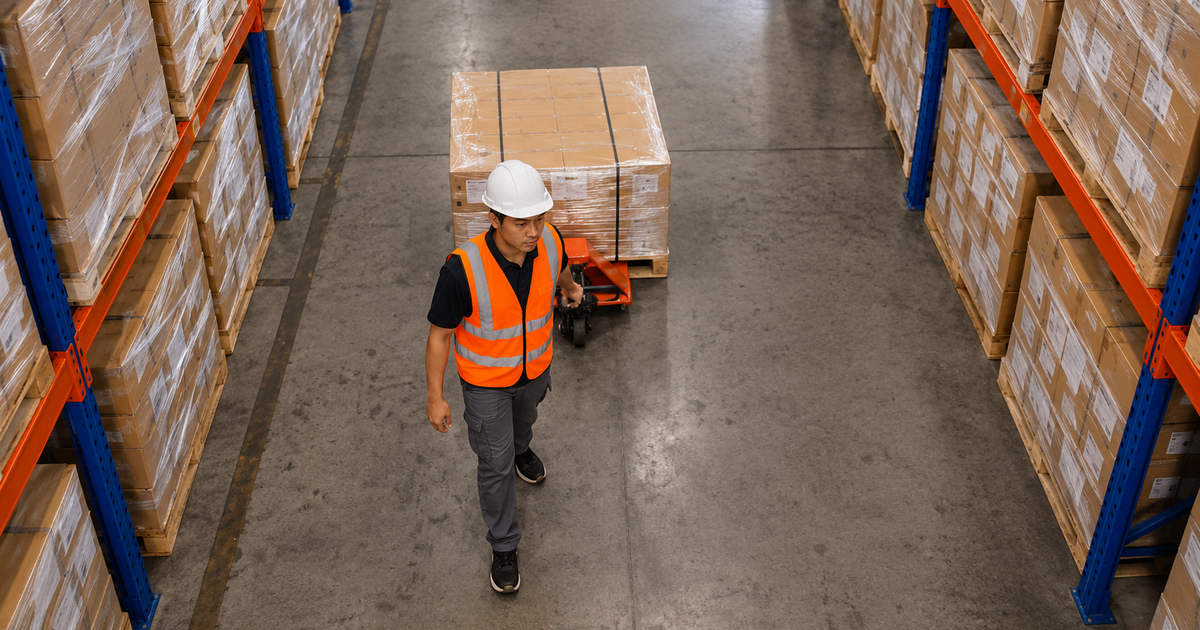
Fulfillment costs rarely fall in step with order volume. A cheaper parcel rate can still raise the cost per order, once damage, reshipments and returns are added in. Insourcing gives brands direct control, while outsourcing to a third-party logistics (3PL) provider shifts many warehouse expenses into service charges that can vary with usage and order volume.
What Is the Difference Between Insourcing and Outsourcing Fulfillment?
Insourcing means managing warehousing and order fulfillment with your own people, facilities, and processes, while outsourcing transfers some or all of those activities to a 3PL provider. Both approaches can work, but their cost structures are different.
| Cost factor | In-house fulfillment | 3PL fulfillment |
|---|---|---|
| Warehouse | Lease, utilities, equipment | Reflected in storage and service charges |
| Labor | Direct payroll and management | Variable fulfillment charges |
| Technology | Setup and maintenance | Often part of the 3PL service |
| Scalability | Requires internal expansion | Capacity can be adjusted |
| Operational control | High | Shared with provider |
For a small operation with predictable local demand, insourcing may be practical. However, growing brands must also account for warehouse rent, equipment, hiring, training, management time, packaging materials, and the opportunity cost of employees handling repetitive fulfillment tasks.
A 3PL can shift many of these expenses into service charges. That does not automatically make outsourcing cheaper; it makes the cost structure easier to scale with order volume.
How Can Businesses Compare the True Cost of In-House and 3PL Fulfillment?
The most useful comparison is total fulfillment cost per order, not the warehouse or pick-and-pack rate alone. Businesses should calculate every expense associated with getting one order from inventory to the customer.
Consider these cost categories:
- Facility costs: rent, utilities, security, equipment, and warehouse maintenance.
- Labor costs: receiving, picking, packing, inventory management, supervision, and training.
- Inventory costs: storage space, stock transfers, damaged goods, and excess inventory.
- Transportation: inbound freight, parcel shipping, international shipping, and replenishment.
- Returns: receiving, inspection, restocking, disposal, and customer-service handling.
- Technology: warehouse management systems, integrations, barcode tools, and reporting.
Amazon provides a useful example of why this broader calculation matters. Its current FBA cost structure includes fulfillment and storage costs, along with potential charges for returns processing, aged inventory, removal, and other services. Amazon also provides a Revenue Calculator that lets sellers compare FBA with their own fulfillment method.
For a fair 3PL comparison, brands should therefore request a complete pricing breakdown rather than comparing one advertised per-order fee.
When Does Outsourcing Fulfillment Become More Cost-Effective?
Outsourcing becomes more attractive when fulfillment complexity grows faster than the company’s ability to manage it efficiently. This can happen when order volume increases, customers become geographically dispersed, or a brand begins selling through multiple channels.
For example, a brand shipping from one internally operated warehouse may face increasing parcel costs when most customers are located far from that facility. A 3PL with strategically positioned warehouses can potentially place inventory closer to demand.
This is particularly relevant to Amazon sellers. Amazon supports both Fulfillment by Amazon (FBA) and seller-fulfilled models, and sellers can use different fulfillment methods for different products.
A practical decision framework is:
- Stable, concentrated demand: in-house fulfillment may remain efficient.
- Rapidly increasing orders: outsourcing can reduce the need for immediate warehouse expansion.
- Multiple sales channels: a 3PL can consolidate operational workflows.
- China-based manufacturing with overseas customers: China-based fulfillment can reduce intermediate inventory transfers before final delivery.
- US-focused demand: domestic inventory can reduce dependence on individual cross-border shipments.
How Can Lansil Global Help Control 3PL Logistics Costs?
Lansil Global combines China sourcing, manufacturing support, fulfillment, and logistics services, giving brands an option to coordinate several supply-chain stages through one provider. This can be particularly relevant for growing e-commerce companies that source from China but sell internationally.
Its China 3PL fulfillment service operates from Shenzhen and supports shipping to international destinations, while its US fulfillment operations use warehouses in Pennsylvania and Nevada. Its China fulfillment service can reach 171+ countries, while its US fulfillment service supports domestic order fulfillment.
For Amazon sellers, its Amazon FBA prep services cover inventory management, quality checks, labeling, barcoding, packaging, and shipment to Amazon fulfillment centers from facilities in China and the US. Its FBA preparation network includes a 45,000-square-foot Shenzhen facility, along with preparation facilities in Nevada and Pennsylvania.
Its USA order fulfillment network can also be relevant when a brand needs domestic inventory and returns handling rather than shipping every individual order internationally.
Which Fulfillment Model Should a Growing E-Commerce Brand Choose?
The most suitable model is the one that produces a sustainable total cost while meeting the brand’s delivery, inventory, and service requirements. There is no universal order-volume threshold at which every business should outsource.
Before deciding, calculate the current cost per order and compare it with a detailed 3PL quotation. Include storage, receiving, pick-and-pack, packaging, shipping, returns, inventory transfers, and any account or integration charges.
For brands sourcing in China and selling across multiple markets, the analysis should also consider where inventory enters the fulfillment network. Moving products directly from manufacturing to an appropriate fulfillment location can reduce unnecessary handling and transportation steps.
Lansil Global offers sourcing, manufacturing and quality control, China fulfillment, US fulfillment, Amazon FBA preparation, and China global freight services for e-commerce businesses.
If your fulfillment operation is becoming difficult to scale, contact Lansil Global for a fulfillment quote or consultation. The team can review your sourcing, warehousing, and shipping requirements and help you evaluate a suitable fulfillment structure for your target markets.