For scaling e-commerce brands, few things are more frustrating than preparing a shipment, calculating costs based on the weight on the scale, and then receiving an invoice for a significantly higher amount. This surprise usually comes down to one key logistics principle: the difference between actual weight and volumetric weight. Understanding these two concepts is essential for controlling shipping costs, especially for businesses leveraging Amazon FBA or global fulfillment.
What is Actual Weight?
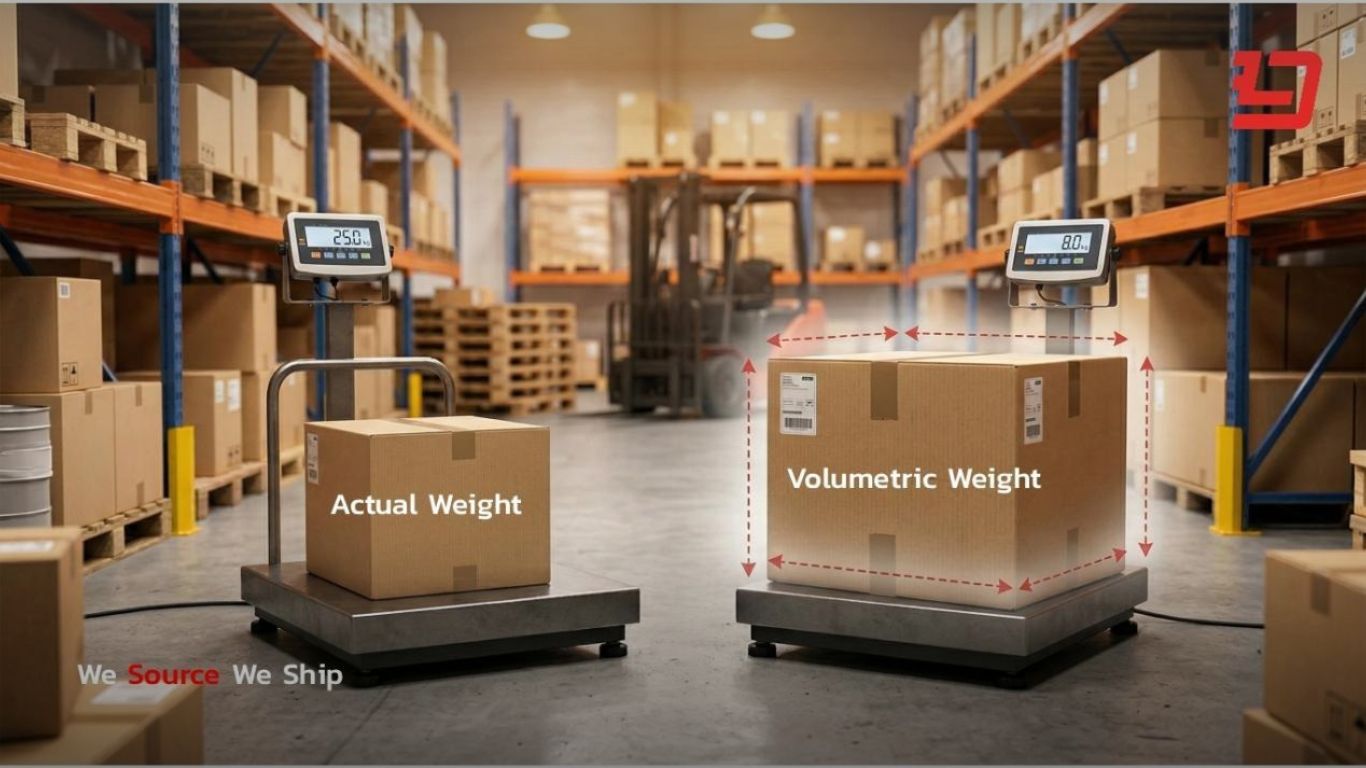
Actual weight is the simplest metric to understand. It is the physical weight of your shipment, including the product, its packaging, and any pallets or containers used. When you place a package on a scale, the number you see is the actual weight—often referred to as the gross weight. For dense, compact items like electronics, tools, or books, this is often the primary cost driver.
What is Volumetric Weight?
Volumetric weight—also known as dimensional weight or DIM weight—is a pricing technique used by carriers to account for the space a package occupies. What volumetric weight is can be best understood by considering the logic behind it: a large, lightweight box (like one containing pillows or empty plastic containers) takes up as much space on a truck or aircraft as a heavy, dense one. To ensure they are compensated fairly for the space used, carriers will calculate a “weight” based on the package’s dimensions.
How to Calculate Volumetric Weight
The formula for calculating volumetric weight depends on the carrier and the units used. The standard calculation is:
Volumetric Weight = (Length × Width × Height) ÷ DIM Factor
- For international shipments (cm/kg): Most express carriers like DHL, UPS, and FedEx use a DIM factor of 5000. Some air freight services use 6000.
- Example: A box measuring 50cm × 40cm × 40cm has a volumetric weight of (50×40×40) ÷ 5000 = 16 kg.
- For US domestic shipments (in the measurement of inches/lbs): FedEx and UPS use a DIM factor of 139. Amazon FBA also uses this standard.
- Example: A box measuring 20in × 18in × 12in has a volumetric weight of (20×18×12) ÷ 139 = 31.1 lbs.
The “ceiling rounding” rule is normally used during the calculation. Carriers round each dimension up to the nearest inch or centimeter before performing the calculation, which may increase the final chargeable weight.
Chargeable Weight: The Golden Rule
Once you have both numbers, the rule is straightforward: the chargeable weight is always the greater of the actual weight or the volumetric weight.
- Heavy Goods: If your product’s actual weight is 20 kg and its volumetric weight is 15 kg, you are billed for 20 kg.
- Bulky (or “Light”) Goods: If your product’s actual weight is 10 kg but its volumetric weight is 18 kg, you are billed for 18 kg.
For businesses selling lightweight, bulky items like apparel, plush toys, or shipping products with protective packaging, the volumetric weight often dictates the final shipping cost.
Strategies to Reduce Dimensional Weight Costs
High volumetric weight doesn’t have to be a permanent profit drain. Optimizing your packaging can yield significant savings.
- Right-Size Your Packaging: Eliminate unnecessary box sizes. Use the smallest possible carton that safely accommodates your product. Avoid the common trap of “one box fits all.”
- Use Poly Mailers for Soft Goods: For non-fragile items like t-shirts or bedding, replacing a rigid box with a lightweight poly mailer can dramatically reduce the package’s dimensions, slashing volumetric weight.
- Vacuum Seal or Nest Components: For bulky soft goods (jackets, pillows) or stackable items, use vacuum compression or nest components inside one another to minimize volume.
How a 3PL Partner Simplifies the Equation
Managing these calculations across multiple SKUs and fulfillment centers can become complex. This is where a specialized partner like Lansil Global provides strategic value. As an end-to-end supply chain company with operations in China and the US, Lansil Global helps brands navigate these cost drivers through smart fulfillment strategies.
For example, our direct China fulfillment service offers 5-8 day shipping to the US, which can be a cost-effective alternative for bulky items where holding inventory in expensive US warehouses might not be ideal. Conversely, for fast-moving, denser goods, our USA order fulfillment network (with centers in Nevada and Pennsylvania) enables 2-4 day delivery, optimizing for speed. We also offer professional Amazon FBA prep services to ensure that inbound shipments to Amazon are dimensioned correctly, helping sellers avoid post-shipment billing adjustments.
Furthermore, Lansil Global’s team can create tailor-made packaging based on client needs or conduct packaging inspections, leveraging our internal quality control team to ensure that shipments reach customers reliably, all while maintaining optimal cost efficiency.
Understanding the difference between actual weight and volumetric weight is not just a logistics detail—it’s a core component of e-commerce profitability. By mastering how to calculate these figures and implementing smarter packaging strategies, you can take control of your shipping costs.
For growing brands, partnering with an experienced 3PL like Lansil Global ensures that these optimizations are handled seamlessly, allowing you to focus on scaling your business with confidence. For more about Lansil Global’s services, you are more than welcome to reach out to us here!